


Clinical Characteristics
Ocular Features
The conjunctiva and eyelids are prominently involved as part of the generalized mucocutaneous disease. Keratinization of the lid margins, absent lacrimal puncta, trichiasis, cicatrizing conjunctivitis, entropion, ectropion, blepharitis, sparse eyelashes, and symblephara are important features. The cornea is also involved with keratinization of the epithelial surface and vascularization. The nasolacrimal duct is sometimes blocked. At least one patient has been reported to have an exudative retinopathy.
Systemic Features
Dyskeratosis congenita consists of a heterogeneous (genetic and clinical) group of inherited bone marrow failure and premature aging syndromes with the common feature of shortened telomeres. There is considerable variability in the clinical features. Prominent manifestations include nail dysplasia, oral leukoplakia, abnormal dentition, and reticulated skin pigmentation. Some patients have cognitive impairments. Liver failure, testicular atrophy, pulmonary fibrosis, aplastic anemia, and osteoporosis along with features of aging such as premature grey hair and loss are typical. There is an increased risk of malignancies, especially acute myelogenous leukemia. Bone marrow failure is the major cause of early death.
Genetics
Inheritance
At least three autosomal dominant, three autosomal recessive, and one X-linked form of dyskeratosis congenita are recognized. Mutations in at least 7 genes have been implicated.
Autosomal dominant disease can result from mutations in the TERC gene (DKCA1; 3q36.2; 127550), the TERT gene (DKCA2; 5p15.33; 613989), and the TINF2 gene (DKCA3; 14q12; 613990). Mutations in the TINF2 gene are also responsible for Revesz syndrome (268130) with many features of DKC in addition to ocular findings of an exudative retinopathy resembling Coats disease.
Autosomal recessive disease is caused by mutations in the NOP10 (NOLA3) gene (DCKB1; 224230; 15q14-q15), the NHP2 (NOLA2) gene (DKCB2; 5q35; 613987), and the WRAP53 gene (DKCB3; 17p13; 613988). Mutations in the TERT gene may also cause autosomal recessive disease known as DKCB4 (613989).
The X-linked disease (DKCX) (Zinsser-Engman-Cole syndrome) results from a mutation in the DKC1 gene (Xq28; 305000). The same gene is mutated in Hoyeraal-Hreidarsson syndrome (300240) which some consider to be a more severe variant of dyskeratosis congenita with the added features of immunodeficiency, microcephaly, growth and mental retardation, and cerebellar hypoplasia.
The majority of mutations occur in genes that provide instructions for making proteins involved in maintainence of telemeres located at the ends of chromosomes. Shortened telomeres can result from maintainence deficiencies although the molecular mechanism(s) remain elusive.
Pedigree
Autosomal dominant
Autosomal dominant disorders require only one mutation for the disease to be expressed. Since an affected parent has two chromosomes, only one of which has the mutant gene, parents can expect that half (50%) of their children will receive that one and inherit the disease. It is common for individuals that inherit the mutation, however, to not have evidence of the disease (nonpenetrance).
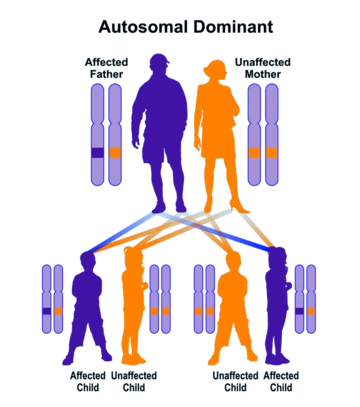
Autosomal dominant inheritance leads to a vertical pattern of transmission
Autosomal recessive
In order for autosomal recessive disorders to be expressed, offspring generally must inherit two mutations, one from each carrier parent. Carriers with only one mutation, such as the parents, do not have clinical disease. Note that carrier parents can expect that 1 in 4 children (25%) will inherit both mutations and have the disorder, 2 in 4 children (50%) will be carriers like their parents, while 1 in 4 children (25%) inherit neither mutation.

In order for autosomal recessive disorders to be expressed, offspring generally must inherit two mutations, one from each carrier parent. Carriers with only one mutation, such as the parents, do not have clinical disease. Note that carrier parents can expect that 1 in 4 children (25%) will inherit both mutations and have the disorder, 2 in 4 children (50%) will be carriers like their parents, while 1 in 4 children (25%) inherit neither mutation.
X-linked recessive, carrier mother
X-linked disorders are caused by a mutation on the X chromosome and both sexes can pass this to their children. If the mutation is in a recessive gene and carried by the mother, she usually does not have the disease since the normal X chromosome without the mutation neutralizes the mutation in the abnormal X chromosome. However, half her sons will inherit the mutation-containing X chromosome and therefore have the X-linked disease. Half the daughters will inherit the mutation-bearing X chromosome and are usuallly healthy 'carriers'.

X-linked disorders are caused by a mutation on the X chromosome and both sexes can pass this to their children. If the mutation is in a recessive gene and carried by the mother, she usually does not have the disease since the normal X chromosome without the mutation neutralizes the mutation in the abnormal X chromosome. However, half her sons will inherit the mutation-containing X chromosome and therefore have the X-linked disease. Half the daughters will inherit the mutation-bearing X chromosome and are usuallly healthy 'carriers'.
X-linked recessive, father affected
X-linked disorders are caused by a mutation on the X chromosome and both sexes can pass this to their children. If the mutation is in a recessive gene and carried by the father, he has the disease since his only X chromosome is mutant and he has no normal X to blunt the effects of the abnormal gene. His sons only receive his Y chromosome and thus are all normal. However, all his daughters receive his one and only X chromosome and will be healthy 'carriers'. Thus such males will have no affected children but half their grandsons from those daughters will have the same disease as he does.

X-linked disorders are caused by a mutation on the X chromosome and both sexes can pass this to their children. If the mutation is in a recessive gene and carried by the father, he has the disease since his only X chromosome is mutant and he has no normal X to blunt the effects of the abnormal gene. His sons only receive his Y chromosome and thus are all normal. However, all his daughters receive his one and only X chromosome and will be healthy 'carriers'. Thus such males will have no affected children but half their grandsons from those daughters will have the same disease as he does.